
Impossible Coincidences: Side by Side
Part One

In Impossible Coincidences, Side by Side part 1, I have chosen to use actual photographs of the documents themselves.
Normally, I prefer to quote records rather than reproduce them. Documents can be difficult to read, and images often distract from the larger story.
This situation is different.
If someone had described these dismissal summaries to me without showing me the documents, I would have struggled to believe them myself.
The differences are not matters of interpretation.
They are visible.
In the first two installments of Impossible Coincidences, you saw that the page numbers in Document One were partially obscured in an identical way throughout the entire dismissal summary. You also saw that the content in Document One had shifted while the headings remained the same.
The print dates were different.
The content was different.
Yet the electronic signature remained exactly the same.
For years I assumed there had to be a simple explanation.
After all, these records originated from one of the largest and most respected medical institutions in the world. The possibility that multiple versions of the same dismissal summary could exist with differing content seemed far less likely than the possibility that I was misunderstanding what I was seeing.
That is why I am showing the documents themselves.
Not because they prove a conclusion.
But because they allow readers to see exactly what I saw.
The question is no longer whether I interpreted the records correctly.
The question is whether these documents can be reconciled with one another at all.
What follows is not a comparison of opinions.
It is a comparison of documents.
Placed side by side.
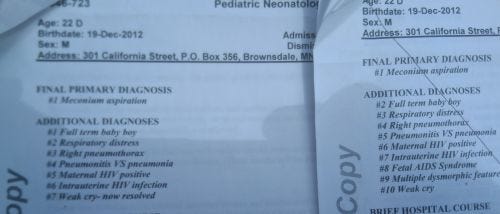
In the above view of the actual documents, you can see the opening heading are the same on both. Both documents each contain eight pages.
This is where “meconium aspiration” finds its permanency in all three accounts under “FINAL PRIMARY DIAGNOSIS” That sounds very legal and binding and yet no one in the room that day said the word aspiration
The phrase doesn’t appear as: possible meconium aspiration or concern for aspiration or aspiration could not be excluded. Instead it is listed as;
FINAL PRIMARY DIAGNOSIS
Meconium aspiration.
That diagnosis survives every one of the three versions. Yet when I returned to the records surrounding Rico’s birth, something stood out.
No one in the delivery room described aspiration.
Meconium was present. But the nurses documented clear lungs.
No wheezes.
No crackles.
Hours later, a consultant arrived because of meconium-stained amniotic fluid. Even then, the examination continued to describe clear lungs.
Yet by discharge, aspiration no longer appeared as a possibility. It appeared as a final diagnosis. The word had completed its journey. What began as an observation became an explanation.
What became an explanation became a conclusion.
And once it entered the dismissal summary as a final diagnosis, it acquired a permanence that the people in the delivery room never gave it.
Back to the dismissal summarys.
In the left hand version under Additional Diagnoses you see;
Full term baby boy
Respiratory distress
Right pneumothorax
Pneumonitis vs pneumonia
Maternal HIV positive
Intrauterine HIV infection
Weak cry — now resolved
In the right hand version you see with the partially covered page numbers you see;
Full term baby boy
Respiratory distress
Right pneumothorax
Pneumonitis vs pneumonia
Maternal HIV positive
Intrauterine HIV infection
Fetal AIDS Syndrome
Multiple dysmorphic features
Weak cry
The right-hand version contains two diagnoses that are absent from the left-hand version:
Fetal AIDS Syndrome
and
Multiple dysmorphic features
Those are not minor wording differences. Those are additional diagnostic characterizations.
Weak cry
becomes
Weak cry — now resolved which changes the status of the condition.These are no longer formatting changes. That’s not a page-number issue.
That’s a change in content.
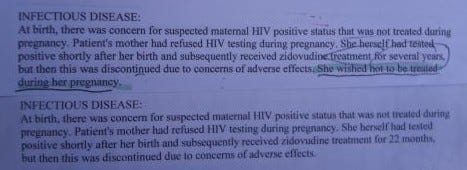
In the image above, two changes stand out.
One is important.
The other is foundational.
The first concerns Lindsey’s childhood treatment history.
In Document One, Lindsey is described as having been treated “for several years,” a phrase that leaves the impression that prolonged treatment was both routine and tolerated.
In the other two dismissal summaries, the description changes.
Lindsey is said to have received treatment for only 22 months before it was discontinued because of concerns about adverse effects.
That distinction matters because one statement implies successful long-term treatment.
The other acknowledges that treatment ended because of harm.
But it is the second change that stops everything.
In Document One appears a single sentence:
“She wished not to be treated during her pregnancy.”
That sentence does not appear in the other dismissal summaries.
It disappears.
To an unfamiliar reader, the difference may seem minor.
It is not.
The entire justification for what followed rests on the idea that Lindsey refused treatment.
That she knowingly rejected care.
That she created the risk.
That sentence is not a background detail.
It is the foundation upon which the rest of the narrative stands.
Without it, the story changes.
Because elsewhere in the record, a different picture emerges.
A picture in which treatment was never offered.
A picture in which no documented refusal exists.
A picture in which omission and refusal are not the same thing.
For more than a decade, courts, physicians, social workers, and legal filings would operate as though the distinction no longer mattered.
Yet here, in three dismissal summaries carrying the same electronic signature, the sentence appears in one version and vanishes from the others.
Not revised.
Not corrected.
Not explained.
Simply present in one story and absent from the next.
Those in power have the predisposition to blame others when things go wrong, while protecting themselves and their tribe. It's a product not of high intelligence and integrity but of low emotional intelligence and low fortitude coupled with high arrogance and dangerously excessive hubris. Health professionals believe that ill-health is caused by poor lifestyle choices when it's actually a dismal failure on the part of the system. When one person is poisoned (by AZT or poppers, for example) it's the individual's choices that are focussed on (impossible coincidences), not that the system, advocates and authorities have encouraged their use (the most likely reason) - based on distorted assumptions, research, facts and announcements. We are all victims of this ongoing broken model and sorry to say Steve, we are all paying the price.